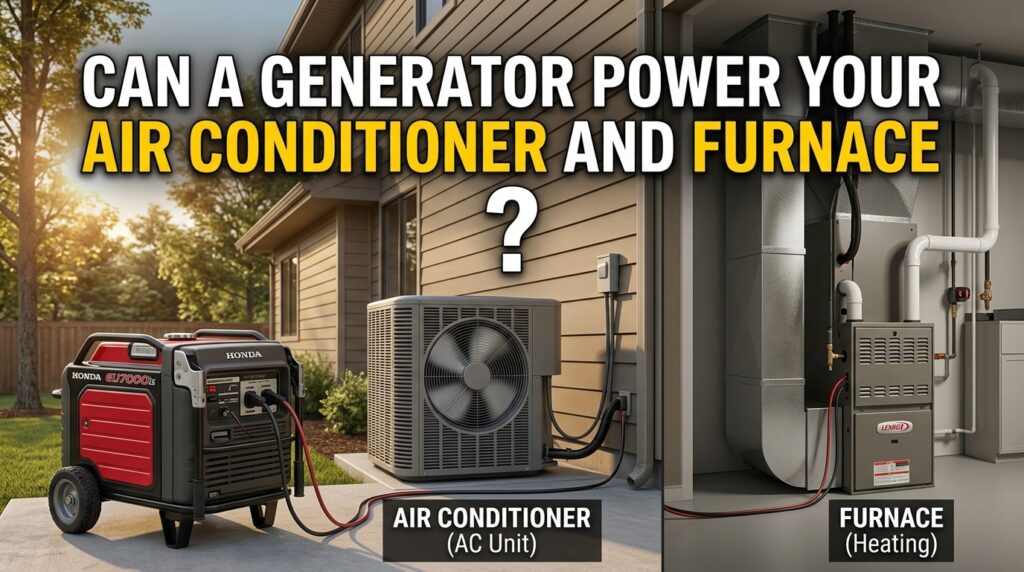
We get this question constantly, usually right after a storm knocks the power out for the third time in a season: can a generator actually run my central air or my furnace, or am I stuck sweating it out or freezing until the utility crew gets to my street? The short answer is yes, a generator can absolutely run your HVAC system. The longer, more useful answer is that it depends entirely on sizing it correctly, and many homeowners get that part wrong.
Why This Question Matters More in Connecticut Than People Think
This isn’t a hypothetical concern here. Connecticut’s grid takes a real beating every storm season. A single December 2025 storm knocked out power to more than 50,000 Eversource customers statewide, with United Illuminating reporting another 5,600 outages on top of that. Just months earlier, a blizzard prompted Eversource to activate its highest-level emergency response plan, preparing for a scenario where several hundred thousand customers could be without power for up to six days. Multi-day outages aren’t rare exceptions in this state; they’re a predictable part of a Connecticut winter, and increasingly, of summer storm season too.
The Real Challenge: Starting Watts, Not Running Watts
Here’s the part that trips people up when they’re shopping for a generator online: the number that matters most isn’t how much power your AC or furnace blower uses once it’s running. It’s the burst of power it needs to start. When an AC unit first turns on, it requires a surge of power to get the compressor and fan motor going; this initial burst, known as inrush current, can be two to three times higher than the unit’s normal operating power.
The starting watts are the tricky part: the compressor demands a big burst of power to get going, and that burst can be three to five times higher than the running watts, which is exactly why homeowners are often told to buy a much larger generator than they’d expect from just the running numbers.
For a typical central AC system, that means a 3-ton central AC system typically demands at least 10,000 to 15,000 starting watts, even though its actual running load is a fraction of that. Size a generator to the running wattage alone, and the unit will trip breakers or stall the generator every single time the compressor kicks on, which is one of the most common calls we get after someone buys an undersized unit off a big-box shelf.
Soft Starters Change the Math
There’s a piece of equipment that makes a real difference here, and it’s worth knowing about before you buy a generator sized for worst-case starting watts. A soft starter is a small device that smooths out that initial surge instead of letting the compressor draw full inrush current all at once. A soft starter can reduce a central AC’s startup current by up to 75%, which means a 4-ton AC that would normally need a 17,000-watt generator could run on a generator closer to 7,100 watts instead. That’s the difference between needing a large, expensive whole-home standby unit and being able to run your system comfortably on something considerably smaller. For homeowners trying to size a generator on a tight budget, or who already own a generator that’s a bit undersized for their AC, a soft starter is often a more practical fix than buying a much larger unit.
Whole-Home Standby vs. Portable: What Actually Handles HVAC Well
Portable generators can run a central AC or furnace, but only with the right setup, specifically a transfer switch, since HVAC systems are hardwired and can’t just be plugged in. Powering a hardwired AC with a portable generator requires a transfer switch; it’s the only safe way to power a hardwired device with an external generator. That said, portables tend to be a tighter squeeze on capacity once you factor in everything else running in the house at the same time, including the refrigerator, sump pump, lights, and the HVAC system’s starting surge, all competing for the same limited output.
A properly sized whole-home standby generator sidesteps most of this. It’s installed permanently, wired directly into your home’s electrical panel, and switches on automatically within seconds of an outage, which matters a lot in a Connecticut winter, when a furnace going cold for even a few hours in a poorly insulated older home can mean frozen pipes by morning.
What We Recommend
Before buying anything, get an actual load calculation done rather than guessing off a generic chart. Your specific AC tonnage, furnace blower motor, and everything else you want running simultaneously, including your well pump, refrigerator, and lights, all factor into the right size. If you’re working with a smaller or existing generator and your HVAC system keeps tripping it on startup, ask about a soft starter before assuming you need to replace the whole unit; it’s often the cheaper fix. And if you’re sizing a system from scratch for a Connecticut home, plan around your area’s real outage history, not just a “worst case” chart because here, worst case shows up more often than people expect.
Have more questions about choosing the right generator for your home or business? Contact our team today.