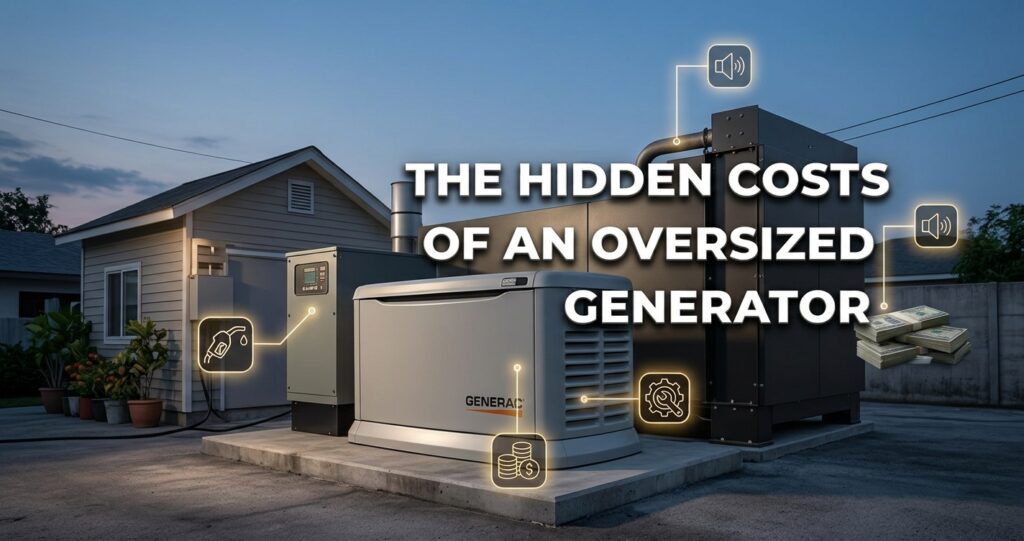
Most conversations about generator sizing focus on the risk of buying too small, and for good reason, since an undersized unit that trips or stalls during a storm is a real problem. However, we spend just as much time talking clients out of the opposite mistake. Oversizing feels like the safe choice with more power, more headroom, and more peace of mind. In practice, it creates its own set of problems, some of which are expensive and some of which can genuinely shorten the life of the generator itself.
The Upfront Cost Problem Is the Obvious One
Let’s start with the part that’s easy to see coming: a bigger generator costs more, full stop. Oversizing raises cost unnecessarily, and you’re essentially paying for a larger amount of power you won’t use. That’s not a small difference either; diesel units alone can run anywhere from $5,000 to $18,000 depending on capacity. And every step up in kW rating adds real dollars to both the equipment and the installation. We’ve seen this play out directly with customers who came to us after getting a quote elsewhere.
The Bigger Issue Shows Up After Installation
The upfront cost is the part most people anticipate. What catches people off guard is what happens to the generator itself once it’s running. Generators work best at 50 to 75 percent of their rated capacity. Running an oversized unit consistently below that range wastes fuel and leads to higher operating costs over time, and fuel waste is really just the beginning.
For diesel units specifically, chronic underloading causes a well-documented mechanical problem called wet stacking that we have discussed in our previous posts as well. The characteristics that make diesel engines so effective at high loads pose a real reliability issue when they’re run lightly loaded.
When operating temperatures stay below designed levels, fuel combustion becomes incomplete, and the products of that incomplete combustion deposit onto internal engine parts like pistons, piston rings, and exhaust valves. In many standby projects, a 500 kVA unit ends up routinely supporting only 100 to 150 kVA of actual load, which means the generator runs at roughly 20 to 30 percent of its rated capacity for most of its service life. This is exactly the range where this kind of damage accumulates.
The mechanism is worth understanding, because it explains why “just get a bigger one to be safe” isn’t actually the safer choice. When a diesel engine runs consistently below about 30 percent of rated output, combustion is inherently incomplete, and the injectors deliver fuel calibrated for higher output. The engine doesn’t generate enough heat to fully combust it, and the excess ends up as unburned residue in the exhaust system. When those deposits build up heavily, they can restrict exhaust flow, causing excess back pressure that reduces performance or can even trigger a shutdown.
Why This Matters for Monthly Testing, Not Just Outages
Here’s the part that surprises a lot of owners: an oversized generator doesn’t just underperform during the rare week it’s actually needed. It’s also underloaded every month during routine exercise testing. The main cause of wet stacking in standby applications is oversizing at the project design stage, often driven by unclear client load requirements when the system was first specified. If your generator is sized well beyond what your home or business actually draws, that gap shows up every time it cycles on for its scheduled test run, not just during a real emergency.
It’s Not Just a Diesel Problem
Wet stacking is specific to diesel units, but the financial waste of oversizing isn’t. Natural gas generators handle low loads better and don’t experience wet stacking, but they still waste fuel when oversized, so switching fuel types doesn’t make the sizing question disappear; it just removes one specific failure mode from the list.
The Other Costs Nobody Mentions
A few smaller issues tend to come up too. Incomplete fuel combustion increases wear and tear, causing carbon build-up, oil contamination, and damage to internal parts, all of which raise maintenance and repair costs over the unit’s life. Oversized generators can also run at higher RPMs even under light loads, creating more noise than a properly sized unit, which matters more than people expect if the generator sits near a bedroom window or a neighboring property line.
Our Take
Oversizing feels like it’s erring on the side of caution, but it usually just trades one risk for a different, more expensive one. This includes higher upfront cost, wasted fuel every time the unit runs, and for diesel systems, a real mechanical problem that shortens the generator’s useful life. A proper load calculation, done before you buy rather than after, is what actually gets you a system sized for reliability instead of one that’s simply bigger than it needs to be.
Not sure what size generator you actually need? Call AJ Generator for a proper load calculation.